



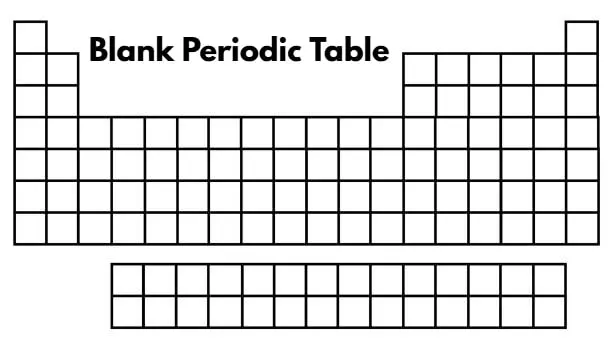
Imagine a giant puzzle with all the pieces missing—they’re there, but empty. That’s what a blank periodic table looks like. But like any good puzzle, filling it in can teach you a lot more than just memorising facts. It helps you see patterns, understand relationships, and retain information in a deeper way. In this article we’ll dive into why using a blank periodic table can be so powerful, how to apply it, a case study and a real-world example, plus practical tips, and at the end, we’ll answer some common questions. If you’re a student, a teacher, or just curious about how elements fit together, you’ll find something useful here.
Why Use a Blank Periodic Table?
Using a blank periodic table isn’t just about filling in names—it’s about engaging with the material. Research shows that when students actively fill in elements rather than passively look at a filled chart, they tend to remember more and understand better.
When you work with a blank table, you have to recall atomic numbers, element symbols and where things go. This builds “mental retrieval” skills. In addition, you begin to notice trends: for example, how atomic radius changes across a period, or how metallic vs non-metallic characters change down a group.
Also, a blank periodic table gives flexibility. You can tailor the exercise: maybe fill only the s- and p-block, or focus on Groups 1, 2, 17 and 18. It makes the learning targeted and interactive.
Bullet Points: Key Benefits
- Memory boost: Regularly filling in the blank table helps you remember element names, symbols and positions. megalecture.com
- Identifying trends: As you place more elements, you start spotting patterns in properties and groups.
- Active engagement: Rather than watching or reading, you do—this leads to deeper learning.
- Customizable practice: You can choose to work with a full blank table or focus on select parts (e.g., transition metals, noble gases).
- Confidence building: With practice you get familiar with the table and feel more comfortable tackling chemistry problems.
How to Use It in Practice
Here’s how you can start using a blank periodic table effectively:
- Print or draw a blank table: You could download a template or draw the boxes yourself (helps memory!).
- Choose a focus area: For beginners maybe fill the first 20 elements; for more advanced learners fill more.
- Fill in gradually: Start with element names, then add symbols, atomic numbers, then properties.
- Repeat often: Practice multiple times, and each time challenge yourself (e.g., try without looking at your notes).
- Spot patterns: After filling, look over the table and ask: Why is this element here? What group is this in? What period?
- Apply to problems: Use the table to answer questions: Which elements are noble gases? Which are alkali metals?
- Use for revision: Before tests, blank tables are low-cost, high-benefit revision tools.
Bullet Points: Practical Tips
- Use colors: Highlight metals, non-metals and metalloids in different colors to visualise groups.
- Time yourself: Try filling the blank table within a timed period to build speed and fluency.
- Mix it up: Sometimes hide symbols and ask for names, sometimes supply atomic numbers and ask for symbols.
- Peer challenge: Work with a friend—who can fill their blank table the fastest and most accurately?
- Use technology: There are online blank periodic tables and games (though the focus here is on the simple paper version).
Case Study: Engaging Students with a Blank Table
Let’s look at a real case. In a high‐school in Ecuador, researchers implemented a guide of “scientific recreations” (games and activities) to help students learn about the periodic table, many of whom had previously struggled with chemistry.
In that study, 60 students worked in groups with games like puzzles, bingo, deck-cards of elements, and a blank table style placement activity. The results showed significant improvement in their ability to place elements, recognise properties, and collaborate. The guide reported that the blank table type activities made learning more attractive, participatory and meaningful.
What we take from this: by using something as simple as a blank periodic table and building interactive activities around it, educators can foster deeper engagement, reduce fear of chemistry, and improve learning outcomes. This supports the idea of “unlocking the power of a blank periodic table”.
Real-World Example: Why the Table Matters Beyond School
You might be wondering: “Ok, but what about the real world—where does a periodic table come into everyday use?” Here’s a clear example:
In material science and engineering, scientists need to know which elements belong to which group to predict behaviour. Suppose a company is designing a new alloy for airplane parts. They look for metals that are lightweight, strong and resistant to corrosion. Using knowledge of the periodic table, they focus on transition metals (d-block) because of their properties. They might ask: “Which elements in period 4, group 6 are possible? What about period 5, group 4?” Because the engineer is mentally visualising, or even uses a blank table to sketch possibilities, they can map options quickly.
Likewise, in environmental science, identifying “noble gases” (Group 18) versus “alkali metals” (Group 1) helps in understanding reactivity, stability, and application (for instance in lighting, welding, or insulation). The blank periodic table fosters a mental picture that supports these real‐world tasks—not just in school but in labs, industry and research.
So by mastering a blank table, you’re developing a tool that expands beyond memorisation—it becomes a framework you carry with you. That’s what it means to truly unlock the power of a blank periodic table.
Conclusion + Call To Action
In summary, using a blank periodic table isn’t just a fun classroom activity—it’s a powerful learning tool. By engaging actively, spotting patterns, customising practice and applying to real‐world thinking, you can deepen understanding, boost memory, and build confidence. Remember the case study: simple games, blank tables, motivated learners—improved results. And in the real world, that mental map of elements helps engineers, scientists and curious minds alike.
Now it’s your turn. Grab a blank periodic table (or draw one), set a timer, start filling it in, spot patterns, challenge yourself and your friends. You’ll see that what looked like empty squares becomes a map of the universe of elements—and a key to unlocking chemistry’s power.
Explore more helpful articles on Blogenzamag.com
If you’d like more resources (blank table templates, games, activity sheets), drop me a line and I’ll share some. Let’s get started!
Frequently Asked Questions (FAQs)
Q1. Do I have to fill in all 118 elements on the blank periodic table at once?
Not necessarily. It’s fine to start with a smaller set—first 20 elements, major groups or blocks—and then expand. The important part is the practice and pattern recognition, not finishing all at once. Some sources suggest focusing on key groups first like Groups 1, 2, 17, and 18.
Q2. Is working with a blank periodic table better than just using a filled one and reading from it?
Yes—because you’re actively recalling and placing information rather than passively reading. This strengthens memory and understanding according to educational research. Q3. How often should I practice using a blank periodic table to see results?
Aim for regular short sessions—for example 10-15 minutes a few times a week. The repetition builds retrieval fluency, and over time you’ll notice you fill in faster and more accurately.
Q4. Can the blank periodic table be used by younger students (e.g., age 10-12)?
Yes! With simplified focus (e.g., first 20 elements or major groups) and guidance, younger students can use a blank table effectively. It can even be turned into a game or colouring activity to build comfort and curiosity.
Q5. Are there digital apps or tools that let me use a blank periodic table?
Yes—there are interactive periodic table apps that allow you to hide information and fill in, or create quizzes based on a blank layout. But the simple paper version is still very effective and easy to use without needing tech. One study suggests games and interactive formats helped students learn better.
The Periodic Table of Chemical Elements: a window on the universe


